Private Gain, Public Loss: How Competitive Private Rates Are Depleting the Investigator Pool Available to NC's Indigent Defense System
Inflation has eroded the real value of compensation rates for cases facilitated through North Carolina’s Office of Indigent Defense Services (IDS), forcing licensed private investigators to abandon or significantly limit public defense cases for higher-paying private work. Consequently, North Carolina’s indigent defendants face a critical shortage of effective investigative support. This paper documents the history of IDS pay rates and analyzes how stagnant wages are driving a talent drain that harms indigent defendants.
NC IDS Private Investigator Pay Rate History
Most Recent Rate Increase: March 1, 2022
On October 29, 2021, the Indigent Defense Services Commission announced an increase in licensed private investigator pay rates by 10%. The Commission’s vote included what IDS described as “long overdue increases” to the rates paid to private investigators and mitigation specialists. The new rates took effect for authorization forms submitted on March 1, 2022, or later. Defense investigators saw their hourly rate increase from $50 to $55 per hour for both capital and non-capital cases.1
Prior Rate History
The Commission noted that the 2022 rate increases were the first since the legislatively mandated rate cuts of 2011, meaning defense investigators went nearly eleven years (2011 – 2022) without a pay increase from IDS.
Bottom Line
| Period | Investigator hourly rate |
|---|---|
| Before 2011 | Higher (then legislatively cut) |
| 2011 – Feb 28, 2022 | $50/hour |
| March 1, 2022 – present | $55/hour |
The last and only increase in the modern era was March 1, 2022, raising the rate by $5/hour (10%).
Purchasing Power Parity
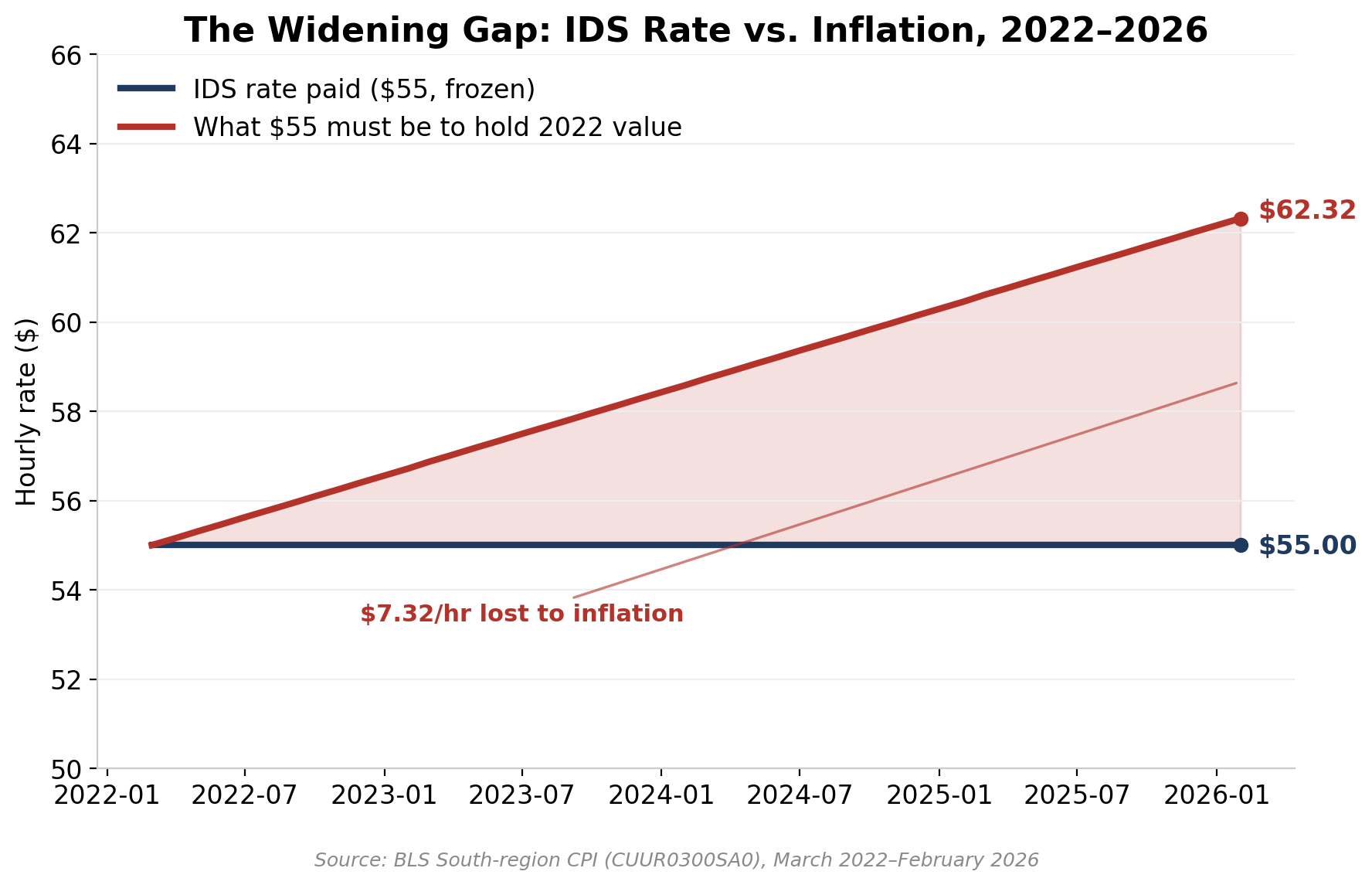
North Carolina falls within the Bureau of Labor Statistics South region. The region’s Consumer Price Index data provides precise index values.2 The $55 IDS rate took effect March 1, 2022. We can use the March 2022 index (278.598) and February 2026 index (315.689) to calculate cumulative inflation.
Examine the math:
- March 2022 index: 278.598
- February 2026 index: 315.689
- Cumulative inflation: (315.689 - 278.598) / 278.598 = 13.31%
- Inflation-adjusted equivalent of $55/hr: $55 × 1.1331 = ~$62.32/hr
- Real purchasing power lost per hour: ~$7.32
How This Affects the Bottom Line
Because the number of hours investigators work per year may differ significantly, we can look at three levels to get an understanding of how defense investigators are negatively affected by the $55.00 current rate.
500 billable hours/year (low workload)
| Billed at current rate | $27,500 |
| What you’d need to keep up with inflation | $31,160 |
| Purchasing power lost annually | -$3,660 |
1,000 billable hours/year (moderate workload)
| Billed at current rate | $55,000 |
| What you’d need to keep up with inflation | $62,320 |
| Purchasing power lost annually | -$7,320 |
1,500 billable hours/year (heavy workload)
| Billed at current rate | $82,500 |
| What you’d need to keep up with inflation | $93,480 |
| Purchasing power lost annually | -$10,980 |
Note: This is an approximation, as we are comparing 2022 to 2026 and not calculating each year incrementally.
The Request: A Specific and Justified Rate Adjustment
Based on the aforementioned history and economic analysis, the evidence supports an immediate increase to the hourly compensation rate for licensed private investigators, along with the adoption of a formal schedule of periodic review going forward to help prevent the issue from reoccurring.
A Mandate, Not a Courtesy
§ 7A-498.1. Purpose.
Whenever a person is determined to be indigent and entitled to counsel, it is the responsibility of the State under the federal and state constitutions to provide that person with counsel and the other necessary expenses of representation. The purpose of this Article is to:
(1) Enhance oversight of the delivery of counsel and related services provided at State expense; (2) Improve the quality of representation and ensure the independence of counsel; (3) Establish uniform policies and procedures for the delivery of services; (4) Generate reliable statistical information in order to evaluate the services provided and funds expended; and (5) Deliver services in the most efficient and cost-effective manner without sacrificing quality representation. (2000-144, s. 1.)
The case for an increase does not rest only on economics. It rests on the statute that created IDS. The Indigent Defense Services Act of 2000 sets out five purposes for the Office, codified at N.C. Gen. Stat. § 7A-498.1: to enhance oversight of counsel and related services provided at State expense; to improve the quality of representation and ensure the independence of counsel; to establish uniform statewide policies and procedures; to generate reliable information to evaluate services and funds; and to deliver services efficiently “without sacrificing quality representation.” The same Act recognizes that the State’s constitutional obligation extends beyond the lawyer alone: it covers counsel “and the other necessary expenses of representation,” and § 7A-498.3(c) places the use of funds for experts and other services related to legal representation squarely within IDS’s authority. Investigative support is not ancillary to that mandate; it is part of it.
Measured against those purposes, a compensation rate frozen since 2022 is not a neutral budget fact. It works against the mandate at nearly every point, as the following summary shows.
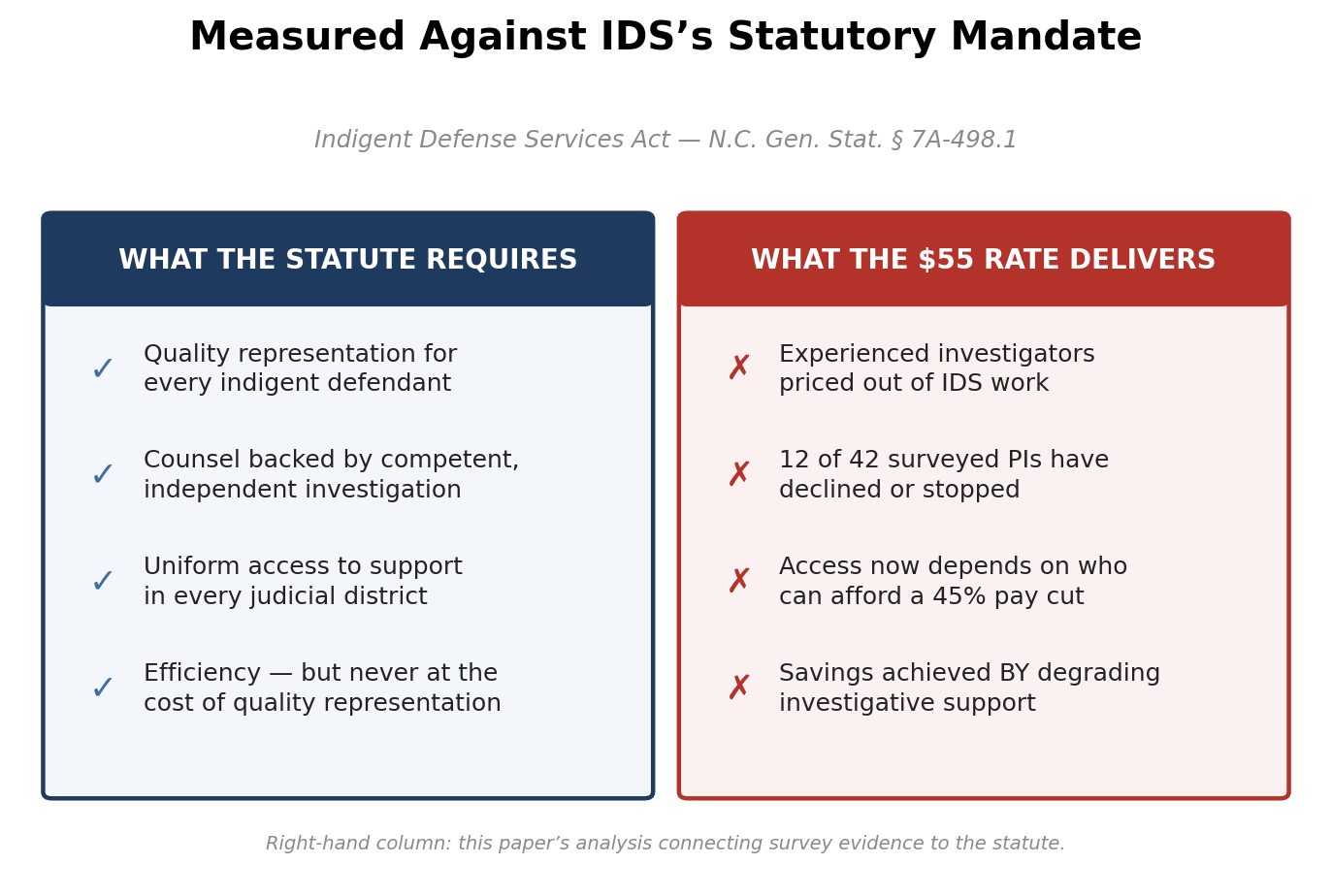
The statute does not direct IDS to minimize the cost. It directs IDS to be efficient without sacrificing quality representation. A rate low enough to drive experienced investigators out of indigent defense work does not satisfy that purpose. It violates its express limitation, achieving savings precisely by degrading the quality of the defense investigation provided. The rate adjustment proposed below is therefore not a concession to investigators. It is what bringing IDS back into alignment with its own governing statute requires. The three calculations that follow establish what that figure should be.
The Suggested Rate and Its Basis
The suggested rate is $75.00 per hour. This is not an arbitrary figure. It reflects three converging calculations:
1. Inflation Adjustment
The current rate of $55.00 per hour has been in place since March 1, 2022. Using Bureau of Labor Statistics Consumer Price Index data for the South region, which includes North Carolina, cumulative inflation from March 2022 through February 2026 stands at approximately 13.3%. Applied to $55.00, that yields an inflation-adjusted equivalent of $62.32 per hour simply to maintain the real value of the 2022 rate.
A rate of $75.00 per hour is meaningfully above that inflation floor, but for good reason: the 2022 rate was itself acknowledged by IDS as “long overdue” after eleven years of stagnation. Restoring only the inflation-adjusted value of a rate that was already inadequate does not solve the underlying problem. It merely resets the clock on a number that was insufficient when it was set.
2. Market Positioning
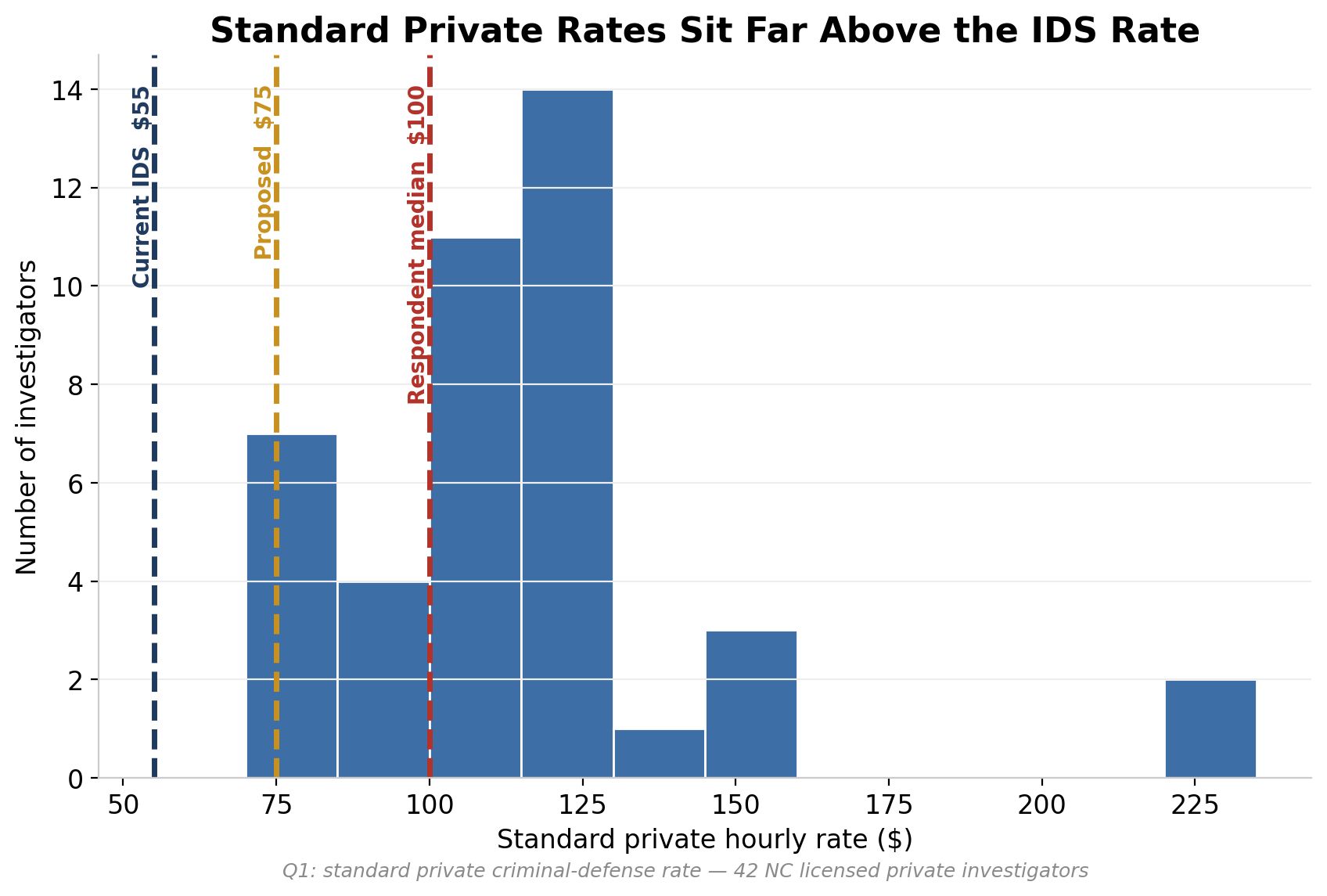
Based on a survey of 42 licensed private investigators in North Carolina performing comparable criminal defense work for private clients, defense investigators commonly bill a median rate of $100 per hour in the current market.3
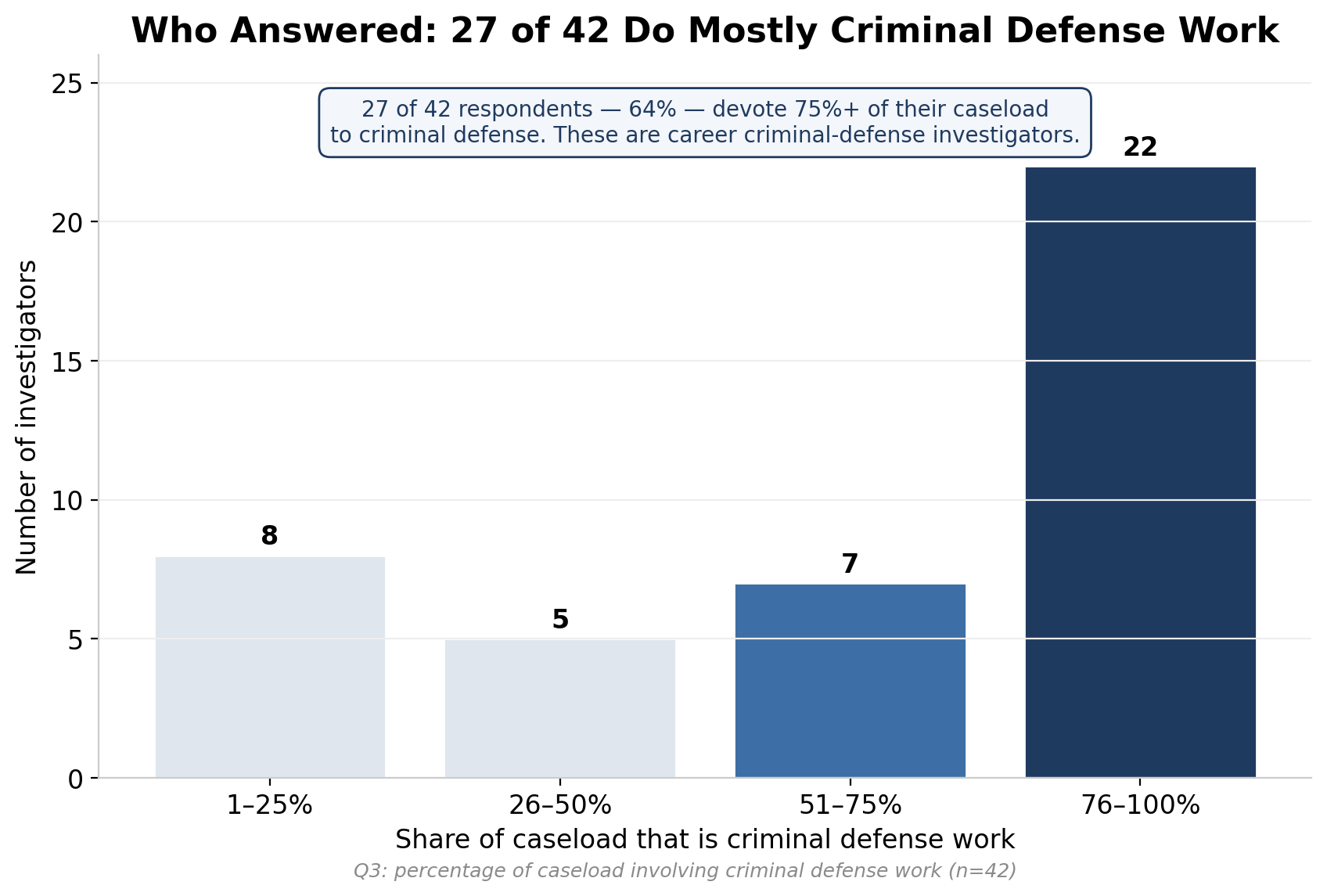
The investigators surveyed are not occasional or peripheral participants in criminal defense work. When asked what share of their caseload involves criminal defense, 27 of the 42 respondents (roughly two-thirds) reported that criminal defense constitutes 75% or more of their practice, and 22 reported a share of 76–100%. This concentration matters: it means the rates reported below reflect the standard billing of investigators whose livelihoods depend on criminal defense work, not figures drawn from generalists for whom such cases are a minor sideline. The market comparison that follows therefore rests on the practices of the very professionals IDS most needs to retain.
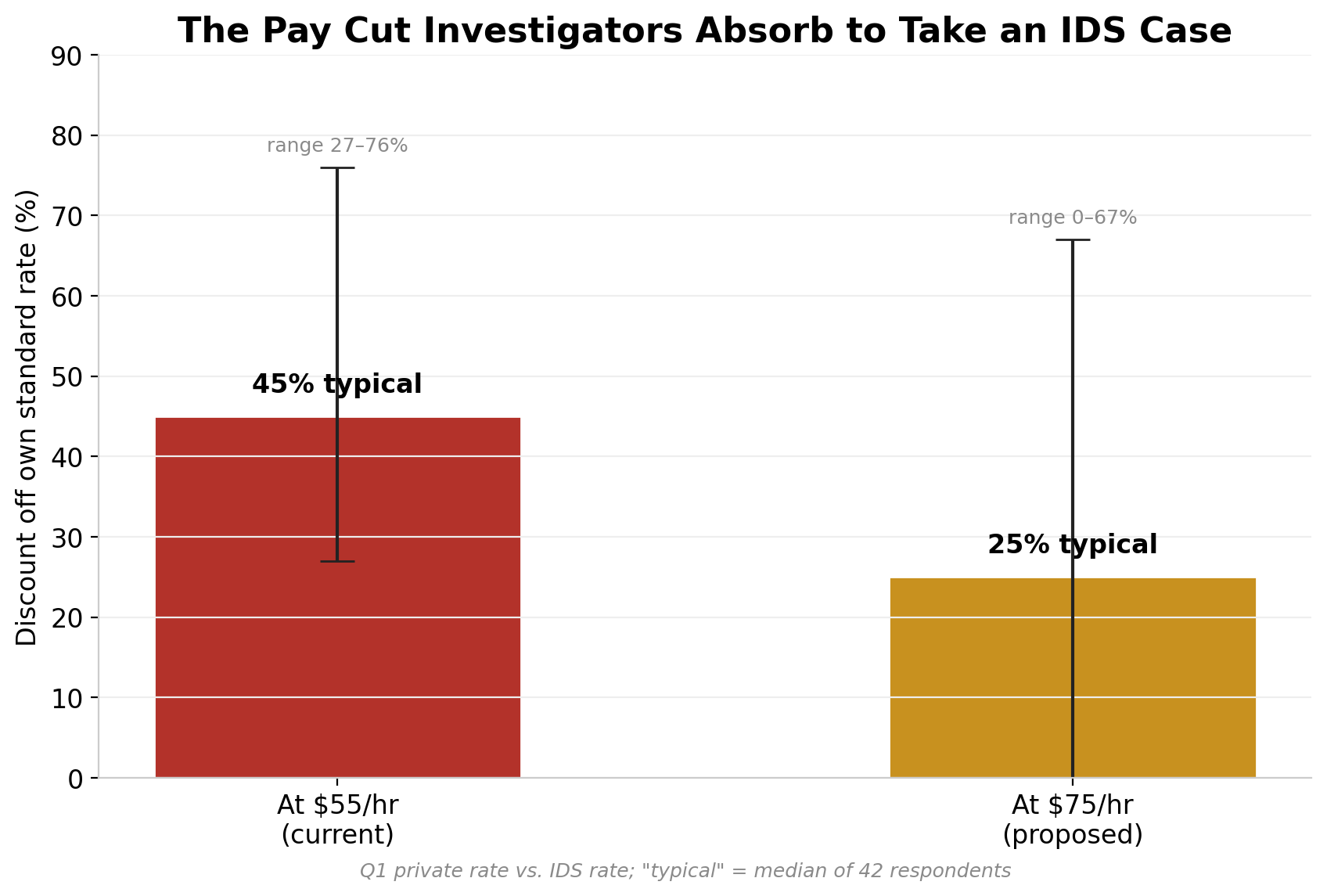
At $55.00 per hour, IDS work requires investigators to accept a discount ranging from 27% below the lowest reported market rate to 76% below the highest, with the typical investigator (billing at the $100 median) taking a 45% cut simply to accept an indigent defense case.
A rate of $75.00 per hour meaningfully narrows that gap: the typical investigator would accept a 25% discount from their standard rate, with the range running from no discount at the low end of the market to 67% for the highest-billing practitioners. That is still a meaningful concession consistent with the professional norms of indigent defense work, but one that does not ask the typical investigator to sacrifice nearly half their hourly income to participate.
Notably, the same survey asked respondents what they would consider a reasonable IDS rate. The median response was $75.00 per hour, the same figure suggested here, indicating the investigators most affected by the current rate regard this as the threshold at which IDS work becomes financially viable.
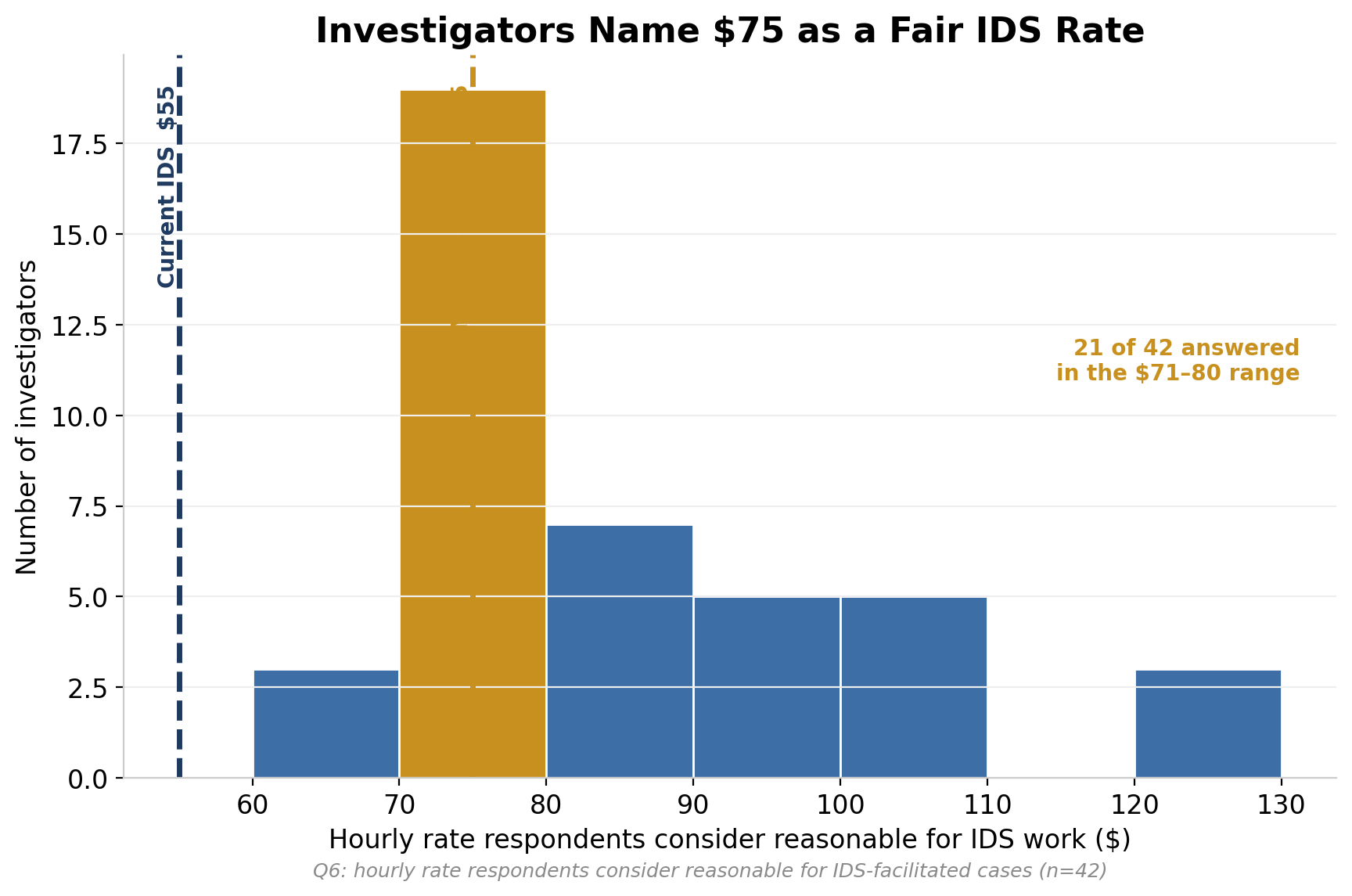
While an increase to $75.00 per hour would not bring IDS rates in line with the market, it makes IDS rates competitive enough that experienced investigators do not feel they must choose between their practice and their public service.
3. The Cost of Operating a Licensed Investigative Practice
Investigators working IDS cases are not employees. They bear the full cost of maintaining a North Carolina private investigator license, required continuing education, professional liability insurance, vehicle expenses, and the administrative overhead of operating as independent contractors. These costs have not been static. Fuel, insurance premiums, and licensing-related expenses have all increased since 2022 in line with or above general inflation. At $55.00 per hour, an investigator billing 1,000 hours annually to IDS cases earns $55,000 in gross revenue, before those operating costs are deducted. The net margin on IDS work was already thin at the 2022 rate; four years of untracked inflation have compressed it further still.
The Cost of Inaction
To be direct about what declining to act means in practice: an investigator billing 1,000 hours per year to IDS cases is currently absorbing an annualized purchasing-power loss of approximately $7,320 relative to the real value of the 2022 rate, and nearly $29,280 over the four years since the raise took effect. Note: This four-year figure is just the annual loss (based on CPI from March 2022 to Feb 2026) multiplied by four. It does not break the loss into year-by-year amounts.
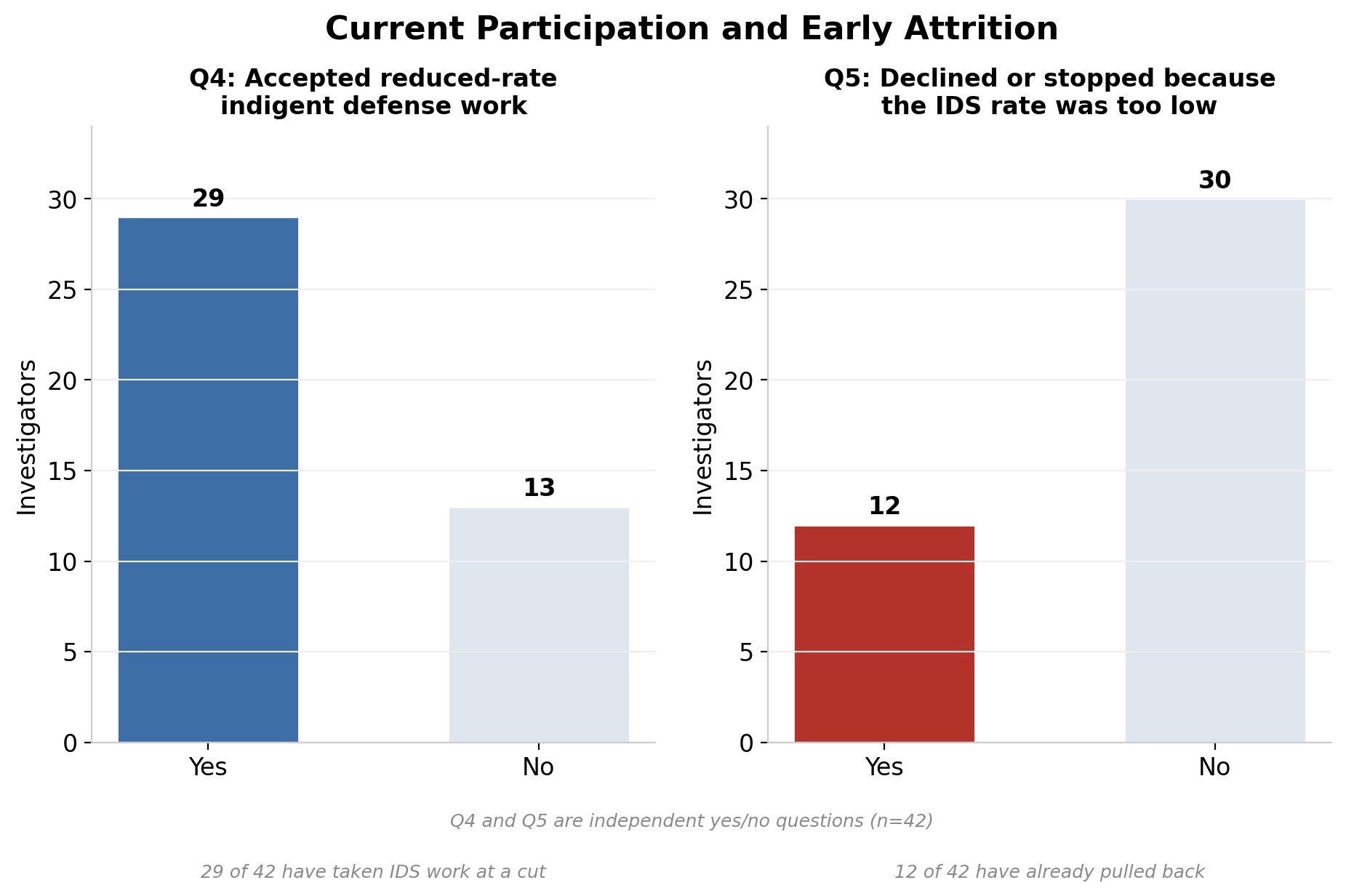
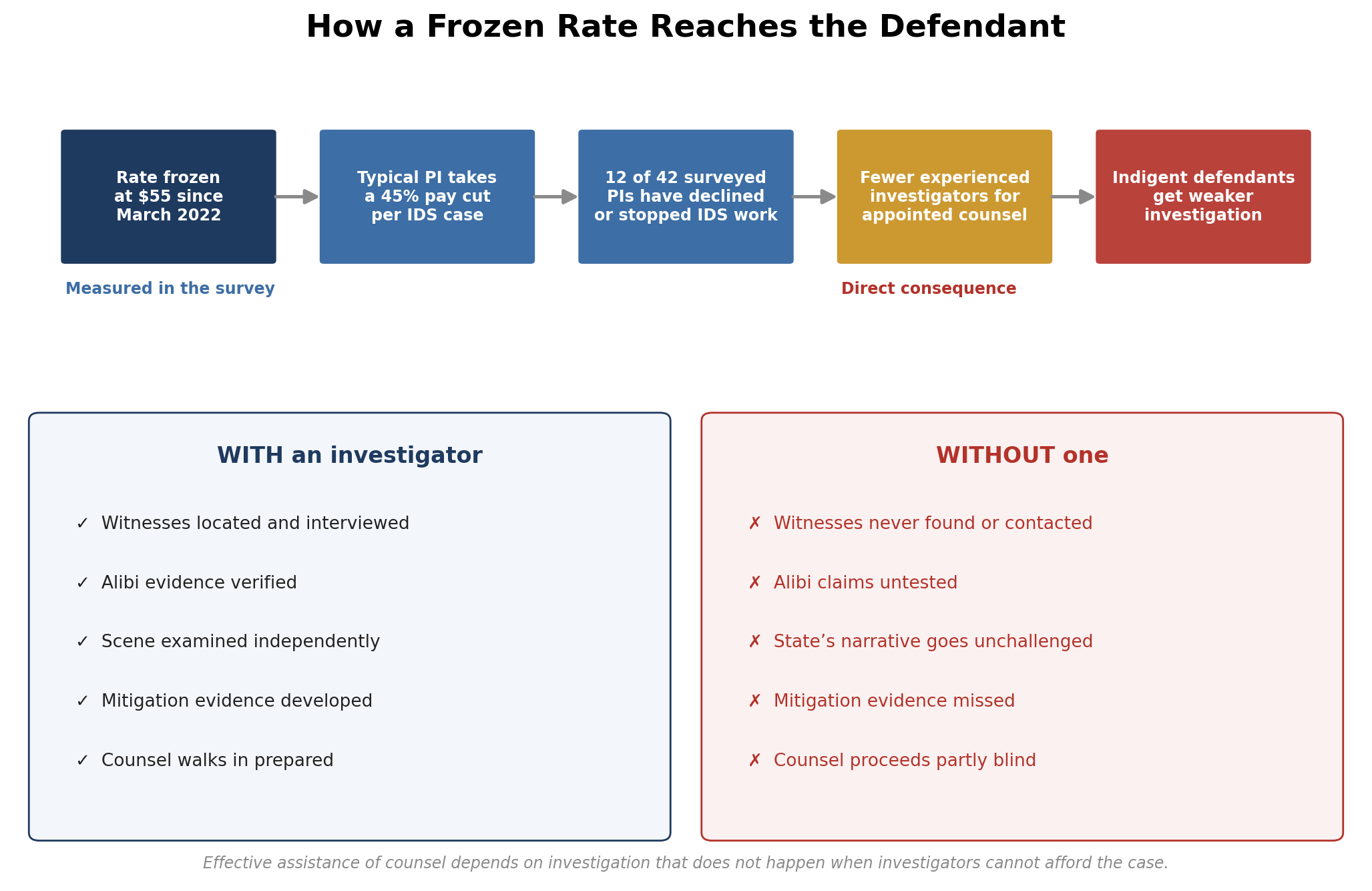
This accumulated financial pressure causes defense investigators to redirect their capacity toward private clients, reduce their IDS availability, or exit the indigent defense market entirely. This erosion is not a future risk; it is already measurable. The same survey asked investigators directly whether they had declined an indigent defense appointment, or stopped accepting them, because the IDS rate was too low. Twelve of the 42 respondents (more than one-quarter) answered yes. This is especially telling given that 29 of the 42 (69%) had accepted reduced-rate indigent work at some point: the investigators leaving are not those who were never willing to serve, but experienced professionals who were willing, did the work, and have since concluded that the current rate no longer makes participation sustainable. Every such departure narrows the pool of available investigators while the financial pressure documented above continues to build.
The Request for Periodic Review
Ideally, IDS would commit to reviewing investigator compensation no less than every two years, using the Bureau of Labor Statistics South region CPI as the benchmark, with any cumulative inflation exceeding 5% since the last adjustment triggering a mandatory rate review. The absence of such a mechanism is what produced the eleven-year freeze that ended in 2022 and what has allowed the current erosion to develop unchecked. Periodic review does not guarantee increases, it guarantees that the question is asked before the damage becomes structural.
Summary
The system does not benefit from investigators who take IDS cases as a last resort. It benefits from experienced, skilled professionals who choose this work in part because the compensation, while not equivalent to private rates, is fair enough to sustain a viable practice. $75.00 per hour is the rate at which that choice becomes reasonable again, and the minimum at which IDS can credibly claim to have addressed the problem.
Appendix: Survey Questions and Responses
The following documents the survey instrument and the complete anonymized response set underlying the market and availability findings in this paper. Forty-two licensed North Carolina private investigators responded. Each respondent is identified only by a sequential number; no identifying information is included.
Survey questions
Q1. What is your standard hourly rate when privately hired for criminal defense work? (Note: Do not include government-mandated rates such as IDS and federal cases; rates through private company vendors such as US Law Shield and similar are acceptable.)
Q2. Approximately how many years have you been working as a licensed private investigator?
Q3. What percentage of your caseload involves criminal defense work?
Q4. Have you ever accepted court-appointed / indigent defense work at a reduced rate?
Q5. Have you declined an indigent defense appointment, or stopped accepting them, because the IDS rate was too low?
Q6. What hourly rate do you feel is reasonable for cases facilitated by the Office of Indigent Defense Services?
Q7. Is there anything else you’d like us to know about criminal defense rates, availability, or barriers to accepting indigent defense appointments? (Free-text; individual responses omitted from this appendix.)
Responses by respondent
| Respondent | Q1 | Q2 | Q3 | Q4 | Q5 | Q6 |
|---|---|---|---|---|---|---|
| 1 | $150 | 7 | 99% | Yes | No | $70 |
| 2 | $135 | 23 | 95% | No | Yes | $75 |
| 3 | $90 | 2 | 95% | Yes | No | $75 |
| 4 | $100 | 4 | 70% | Yes | No | $75 |
| 5 | $120 | 8 | 80% | Yes | No | $95 |
| 6 | $125 | 12 | 20% | No | No | $100 |
| 7 | $150 | 15 | 85% | Yes | No | $100 |
| 8 | $90 | 9 | 99% | Yes | No | $75 |
| 9 | $125 | 4 | 90% | Yes | No | $75 |
| 10 | $100 | 7 | 50% | Yes | No | $75 |
| 11 | $125 | 2 | 10% | No | No | $75 |
| 12 | $75 | 15 | 99% | Yes | No | $75 |
| 13 | $125 | 7 | 100% | Yes | Yes | $95 |
| 14 | $115 | 8 | 90% | Yes | Yes | $80 |
| 15 | $100 | 1 | 20% | No | Yes | $65 |
| 16 | $125 | 1 | 10% | No | No | $100 |
| 17 | $100 | 2 | 30% | No | Yes | $80 |
| 18 | $100 | 10 | 20% | Yes | Yes | $75 |
| 19 | $100 | 8 | 75% | Yes | No | $75 |
| 20 | $125 | 5 | 100% | No | No | $85 |
| 21 | $125 | 2 | 80% | Yes | No | $125 |
| 22 | $85 | 26 | 95% | Yes | No | $75 |
| 23 | $100 | 6 | 30% | Yes | Yes | $75 |
| 24 | $100 | 45 | 10% | Yes | No | $75 |
| 25 | $125 | 3 | 98% | Yes | No | $85 |
| 26 | $150 | 3 | 98% | Yes | No | $100 |
| 27 | $120 | 34 | 80% | Yes | No | $120 |
| 28 | $100 | 10 | 5% | No | Yes | $85 |
| 29 | $80 | 7 | 75% | No | No | $75 |
| 30 | $85 | 14 | 20% | Yes | No | $65 |
| 31 | $225 | 4 | 75% | Yes | No | $75 |
| 32 | $80 | 22 | 99% | Yes | No | $65 |
| 33 | $100 | 21 | 30% | No | No | $75 |
| 34 | $125 | 5 | 98% | Yes | No | $85 |
| 35 | $120 | 8 | 90% | Yes | No | $95 |
| 36 | $75 | 1 | 90% | No | No | $100 |
| 37 | $80 | 7 | 66% | No | Yes | $80 |
| 38 | $225 | 42 | 50% | Yes | Yes | $125 |
| 39 | $75 | 22 | 100% | Yes | No | $75 |
| 40 | $75 | 4 | 95% | No | No | $95 |
| 41 | $125 | 6 | 75% | Yes | Yes | $75 |
| 42 | $100 | 22 | 75% | Yes | Yes | $95 |
Summary of responses
| Measure | Value |
|---|---|
| Respondents | 42 |
| Q1 median private-hire rate | $100/hr (range $75–$225) |
| Q2 median years licensed | 7 (range 1–45) |
| Q3 respondents at 75% or more criminal defense | 27 of 42 |
| Q4 accepted reduced-rate indigent work (“Yes”) | 29 of 42 (69%) |
| Q5 declined or stopped over the IDS rate (“Yes”) | 12 of 42 (29%) |
| Q6 median reasonable IDS rate | $75/hr (range $65–$125) |
-
N.C. Off. of Indigent Def. Servs., Notice of Rate Increase for Private Investigators and Mitigation Specialists (Feb. 28, 2022), https://www.ncids.org/2022/notice-of-rate-increase-for-private-investigators-and-mitigation-specialists/. ↩︎
-
U.S. Bureau of Labor Statistics, Consumer Price Index for All Urban Consumers: All Items in South [CUUR0300SA0], retrieved from FRED, Federal Reserve Bank of St. Louis; https://fred.stlouisfed.org/series/CUUR0300SA0, May 12, 2026. ↩︎
-
Joel Johnson, Private investigator criminal defense private-hire rate survey (May 2026). ↩︎